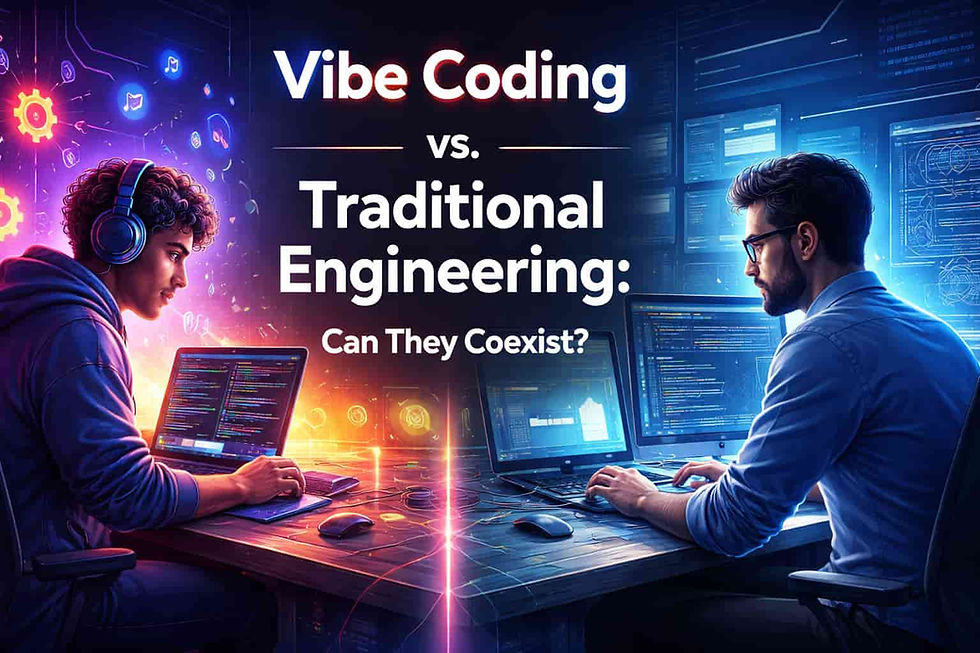
Vibe Coding vs. Traditional Engineering: Can They Coexist?
- Marcus Koch

- Apr 20
- 4 min read
The software development world is undergoing a subtle but powerful shift. For decades, engineering discipline has been defined by structured methodologies, rigorous documentation, and predictable delivery cycles. Today, however, a new approach—often referred to as “vibe coding”—is gaining attention. It emphasizes intuition, rapid experimentation, and creative flow over strict adherence to formal processes. While some see it as a natural evolution of modern development practices, others question whether it undermines engineering rigor.
The real question isn’t which approach is better. It’s whether these two seemingly opposing styles can coexist—and even complement each other—in modern software teams.
What Is Vibe Coding and Why Is It Trending?
Vibe coding is less a formal methodology and more a mindset. It thrives on creativity, fast iteration, and an openness to exploration. Developers working in this mode often rely on instinct, prototyping tools, and real-time feedback loops rather than detailed specifications.
This approach has become more visible due to several current trends shaping the industry. The rise of AI-assisted development, low-code/no-code platforms, and powerful prototyping tools has lowered the barrier to experimentation. Developers can now build, test, and refine ideas faster than ever before, making intuition-driven workflows not only viable but efficient.
Vibe coding also aligns closely with the increasing demand for innovation. In competitive markets, the ability to quickly test ideas and pivot is often more valuable than delivering a perfectly engineered but late solution. Teams working on early-stage products, startups, or experimental features often benefit from this flexibility.
Another reason for its popularity is developer satisfaction. Many engineers feel constrained by rigid processes and find that creative exploration rekindles their passion for coding. This is particularly relevant when working on creative coding projects for software developers, where the goal is not just functionality but also originality and expression.
Traditional Engineering: Why Structure Still Matters
Despite the growing appeal of vibe coding, traditional engineering practices remain the backbone of scalable, reliable software systems. Structured approaches—such as well-defined architectures, testing strategies, and documentation—ensure that software can be maintained, extended, and trusted over time.
Traditional engineering excels in environments where stability and predictability are critical. Industries like healthcare, fintech, and enterprise SaaS require systems that meet strict performance, security, and compliance standards. In these contexts, improvisation alone is not enough.
Moreover, traditional engineering supports collaboration at scale. Large teams depend on shared standards, clear communication, and consistent processes. Without these, projects can quickly become chaotic, especially as complexity grows.
From a career perspective, mastering these fundamentals is essential. Any effective software developer career growth roadmap includes a deep understanding of software design principles, testing methodologies, and system architecture. These skills provide the foundation upon which more flexible and creative approaches can be built.
Where Vibe Coding and Traditional Engineering Intersect
Rather than existing in opposition, vibe coding and traditional engineering can complement each other when applied thoughtfully. The key lies in understanding when and where each approach delivers the most value.
In the early stages of product development, vibe coding can accelerate ideation. Teams can quickly prototype features, validate assumptions, and gather user feedback. This reduces the risk of investing heavily in ideas that may not work.
As the product matures, traditional engineering practices can take over. Prototypes are refined into production-ready systems, with proper architecture, testing, and documentation. This transition ensures that the product remains stable and scalable as it grows.
This hybrid approach is increasingly common in modern development workflows. Agile methodologies, for example, already encourage iterative development and adaptability. Vibe coding can be seen as an extension of this philosophy, emphasizing creativity within iterative cycles.
Another area where the two approaches intersect is tooling. Many modern tools support both rapid experimentation and structured development. Version control systems, CI/CD pipelines, and AI-powered coding assistants allow developers to move quickly without sacrificing quality.
The Role of Emerging Technologies
The coexistence of vibe coding and traditional engineering is further enabled by the top emerging technologies in software development 2026. These technologies are reshaping how software is built, tested, and deployed.
Artificial intelligence plays a central role. AI-powered tools can generate code, suggest optimizations, and even identify potential bugs. This allows developers to focus more on creative problem-solving while maintaining a safety net of automated quality checks.
Cloud-native architectures and serverless computing also contribute to this balance. They reduce the operational burden on developers, making it easier to experiment without worrying about infrastructure constraints.
Additionally, advanced collaboration platforms enable distributed teams to work effectively, regardless of their preferred coding style. Developers can experiment individually while still contributing to a cohesive, well-structured codebase.
These shifts are not just technological—they reflect broader industry insights into how software teams operate. Organizations are recognizing that flexibility and structure are not mutually exclusive but mutually reinforcing.
Building Teams That Embrace Both Approaches
Successfully combining vibe coding and traditional engineering requires intentional team design. Leaders must create environments where experimentation is encouraged but not at the expense of quality.
One effective strategy is to define clear boundaries. For example, teams can allocate specific phases or components of a project to exploratory work, while maintaining strict standards for production code. This allows developers to innovate freely without compromising the overall integrity of the system.
Another important factor is culture. Teams that value both creativity and discipline are more likely to succeed. Developers should feel empowered to experiment, but also responsible for delivering reliable, maintainable solutions.
Mentorship and knowledge sharing also play a crucial role. Experienced engineers can guide less experienced team members in balancing intuition with best practices. This not only improves code quality but also accelerates professional growth.
Finally, tooling and processes should support this dual approach. Automated testing, code reviews, and continuous integration can provide guardrails that allow for creative exploration without introducing unnecessary risk.
Conclusion
Vibe coding and traditional engineering are not opposing forces—they are two sides of the same coin. Each brings unique strengths to the software development process, and their coexistence reflects the evolving nature of the industry.
As technology continues to advance, the ability to balance creativity with structure will become increasingly important. Developers who can navigate both worlds will be better equipped to build innovative, reliable solutions and adapt to changing demands.
Ultimately, the future of software development is not about choosing one approach over the other. It’s about integrating them in ways that maximize their strengths, creating workflows that are both flexible and robust.